
Dec 17, 2025
For sophisticated developers, 3D architectural rendering services are not a marketing expense; they are a strategic tool for de-risking investments and accelerating profitability. This guide moves beyond the aesthetics of visualization to provide a clear framework for leveraging these assets to drive investor confidence, shorten sales cycles, and maximize project returns.
From Blueprints to Buyer Psychology: A Strategic Reframe
For seasoned developers and project teams, 3D architectural rendering represents a fundamental shift in marketing philosophy. The legacy approach—asking stakeholders to interpret flat floor plans and "imagine the possibilities"—is obsolete. Today's market leaders leverage immersive, photorealistic visualization to solve core business challenges, transforming marketing from a project cost into its most valuable asset.
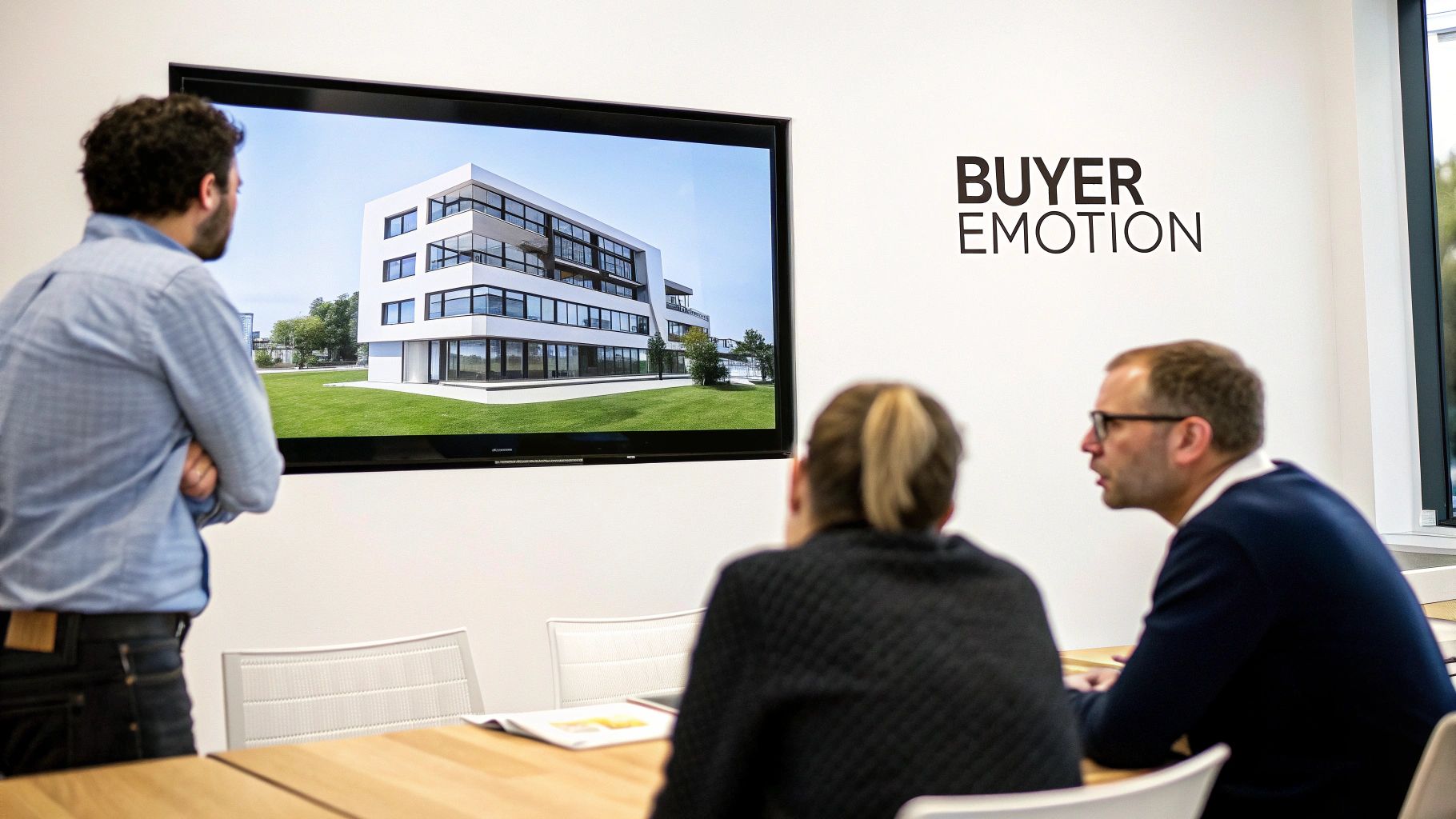
This is not about creating attractive images. It is about closing the gap between an architectural concept and a tangible, emotionally resonant asset. You are no longer asking buyers and investors to imagine the finished building; you are inviting them to experience it. This shift from speculation to certainty has a direct, measurable impact on pre-sales velocity and project profitability.
Shifting From Ambiguity to Certainty
A traditional pre-construction sales strategy sells a concept. A visualization-led strategy sells a reality. By replacing ambiguity with photorealistic clarity, you gain immediate, decisive advantages:
De-risking Capital Investment: Presenting stakeholders and lenders with a hyper-realistic vision of the final asset provides the tangible proof needed to secure capital with confidence. It demonstrates project viability and mitigates perceived risk.
Accelerating Sales Velocity: High-fidelity architectural renderings forge an immediate emotional connection with qualified buyers. This empowers sales teams to shorten the sales cycle and achieve pre-sale targets faster, often before construction commences.
Aligning Stakeholder Vision: From architects to marketing agencies, photorealistic assets create a single source of truth. This unified visual playbook prevents costly misunderstandings, reduces change orders, and ensures all teams are aligned on the final product.
A well-executed rendering does not merely showcase a building; it sells a lifestyle and validates a financial decision. It allows a prospective buyer to project their life into a space, transforming a transaction into an emotional investment.
This guide provides a playbook for integrating modern real estate visualization as a foundational component of a successful launch. By exploring our portfolio of architectural renderings, you can see how these assets are engineered to build buyer confidence and drive pre-sales. The objective is to leverage technology to build belief and generate market momentum from day one.
Translating Vision Into Revenue-Generating Assets
Commissioning 3D architectural rendering services is an investment in a toolkit of strategic sales assets. Each deliverable—from a photorealistic exterior still to an immersive virtual sales gallery—is designed to perform a specific function, whether securing investor buy-in or converting a hesitant prospect into a contracted buyer.
This process transforms architectural plans into marketing horsepower. The market validates this approach: the global 3D rendering market is projected to reach USD 12.67 billion by 2030. This growth reflects a universal understanding among leading developers: high-quality digital assets are essential for pre-construction success.

The Core Asset Toolkit for Pre-Construction Sales
A sophisticated visualization strategy delivers an ecosystem of assets engineered to guide a prospect from initial awareness to a signed contract.
Photorealistic Still Renders: These are the cornerstone of any marketing campaign. As hero shots for websites, brochures, and digital advertising, they establish the project's quality standard and visual identity, instantly communicating premium value.
Cinematic Animations & Fly-Throughs: These assets articulate the project's story and lifestyle proposition. A well-produced animation captures the atmosphere, flow, and unique character of a space in a way static images cannot, making it a powerful tool for investor presentations and high-impact social media campaigns.
Interactive Virtual Tours & Sales Galleries: This is your 24/7 digital sales center. It empowers buyers to explore the property on their terms, from any location. For out-of-market investors and purchasers, this tool is critical for building the confidence required to accelerate a purchase decision.
When your sales team is equipped with a full suite of visualization assets, they stop describing a future and start demonstrating it. This critical shift removes buyer doubt and cultivates the emotional commitment needed to close deals faster.
To achieve this, abstract plans must be converted into assets that are experientially real. Exploring advanced strategies for creating realistic architectural renderings can provide a decisive competitive advantage.
The goal is to build a toolkit mapped directly to your sales funnel. Every asset must have a clear purpose, ensuring that every dollar invested in rendering becomes a direct contribution to accelerating pre-sales and enhancing project profitability.
The Financial Case for High-Fidelity Visualization
For astute developers and investors, high-fidelity 3D architectural rendering services are not an aesthetic choice but a strategic financial instrument. Premium visualization directly impacts the bottom line by accelerating pre-sales, strengthening investor confidence, and ultimately driving a higher return on investment.
The core function of these assets is to translate an abstract architectural concept into a tangible, desirable reality that commands emotional and financial commitment.
Photorealistic renders, cinematic animations, and virtual tours are the fuel for a modern pre-construction sales engine. They equip marketing teams to launch campaigns that create genuine desire and urgency long before a physical sales center is viable. Achieving early sales velocity is critical for unlocking construction financing and de-risking the entire project lifecycle.
Accelerate Sales and Elevate Perceived Value
The psychological impact of presenting a finished, impeccably staged space cannot be overstated. When a prospective buyer can vividly envision their life within a property, the sales conversation elevates from cost-per-square-foot to lifestyle aspiration.
This emotional connection not only generates higher-quality leads but also shortens the sales cycle and justifies a premium price point.
Market data confirms this trend. The demand for 3D rendering services is surging, with the industry projected to reach $5.72 billion—a 500% increase from 2016. This growth is driven by a simple reality: lifelike real estate visualization closes deals more efficiently. Consequently, a significant number of architecture firms now allocate substantial budgets to advanced rendering platforms like D5 Render. You can explore more about AI-driven trends in home rendering here.
By presenting a polished, complete vision from day one, you establish a premium brand perception. This empowers your sales team to command higher prices and defend value, as the buyer is purchasing a tangible, desirable outcome—not just a set of floor plans.
Mitigate Financial Risk Through Clarity
Beyond sales, high-fidelity visualization is a powerful risk mitigation tool. Detailed, photorealistic renderings align all stakeholders—architects, contractors, investors, and internal teams—on a single, unambiguous vision.
This shared understanding is invaluable. It helps prevent expensive, late-stage change orders that arise from misinterpretations of 2D blueprints.
By identifying design ambiguities in the digital phase, you safeguard both budget and timeline. Every potential conflict resolved via a rendering represents significant savings in time and capital during construction. It is the most effective method for ensuring that what is designed is precisely what is built, protecting profitability and fulfilling promises made to buyers and investors.
Visualization Investment vs. Project Outcomes
The following table contrasts the financial and operational outcomes of a traditional marketing approach versus a strategy led by high-fidelity 3D visualization. It demonstrates that an upfront investment in visualization fundamentally improves the financial trajectory of a development project.
Metric | Traditional Marketing (Floor Plans & Sketches) | 3D Visualization-Led Marketing (Renders & Virtual Tours) |
|---|---|---|
Sales Velocity | Slower; requires buyers to interpret abstract plans. | Significantly faster; emotional connection drives quicker decisions. |
Lead Quality | Lower; attracts a wider, less committed audience. | Higher; attracts serious buyers who can visualize the end product. |
Price Premium | Difficult to command a premium based on specs alone. | Easier to justify higher prices by selling a finished lifestyle. |
Financing Access | Slower; lenders see higher risk with unproven sales demand. | Faster; strong pre-sales de-risk the project for financiers. |
Change Orders | Higher risk; misinterpretations of 2D plans are common. | Lower risk; clear visual alignment across all teams. |
Buyer Confidence | Moderate; buyers must trust the developer's vision. | High; buyers purchase with a clear, confident view of their home. |
The choice is between asking your audience to imagine the final product and presenting it to them in undeniable detail. The latter consistently delivers superior financial returns and a more predictable project lifecycle.
Choosing Your Visualization Partner: Beyond the Portfolio
Selecting the right firm for your 3D architectural rendering services is a critical strategic decision. This is not about procuring a commodity; it is about engaging a partner who functions as an integrated extension of your marketing and sales teams.
The most effective partners understand that their primary deliverable is not a beautiful image, but a measurable business outcome. They comprehend the real estate marketing funnel and can articulate how a specific rendering—a dramatic dusk exterior versus a bright, airy interior—will function as a high-performance asset within a targeted campaign. This strategic expertise is what converts visuals into qualified leads and accelerated sales.
Evaluating Beyond the Portfolio
An impressive portfolio is a prerequisite, not a differentiator. To identify a true strategic partner, you must evaluate their process, strategic thinking, and track record of delivering measurable results. Any skilled artist can produce a photorealistic image. A strategic partner ensures that image is precision-engineered to convert your specific target buyer.
While familiarity with the top programs for architectural rendering is expected, a firm’s business acumen and project management discipline are what truly set them apart.
Key evaluation criteria include:
Proven Technical Expertise: Demand mastery of photorealism. Scrutinize lighting, texturing, and composition. The goal is to create visuals so convincing they build immediate trust with a discerning buyer.
Marketing Integration: Does the firm speak the language of sales and marketing? Can they discuss how their assets will integrate with your digital sales funnels, paid media campaigns, and investor decks? They must understand the entire marketing ecosystem.
Disciplined Project Management: A professional firm operates with predictable precision. This means clear communication protocols, structured feedback loops, and an unwavering commitment to deadlines—non-negotiable elements for any complex development project.
Demand Measurable Outcomes
Ultimately, the most important question to ask a potential partner concerns impact. Shift the conversation from "What can you create?" to "What business results have your assets delivered?"
The true measure of a visualization partner isn't the beauty of their renders, but the velocity of the pre-sales they help generate. Ask for case studies that connect their work to accelerated sellouts, enhanced buyer engagement, and improved lead quality.
This focus on ROI separates a service provider from a strategic asset. A partner who can demonstrate how their work contributed to a 27% reduction in rework costs or helped a client achieve pre-sale targets months ahead of schedule provides undeniable value.
To understand how an integrated team operates, review the workflow of a dedicated 3D studio for real estate developers. This approach ensures every rendering is a calculated investment, designed to de-risk your project and maximize returns.
A Look Inside the Production Workflow
The transformation of architectural plans into marketing assets that accelerate pre-sales is a disciplined, multi-stage process. For developers and project teams, understanding this workflow is critical for managing timelines, controlling costs, and ensuring the final deliverables align perfectly with your sales and marketing strategy.
The process begins with precision. Your team provides the foundational documents—CAD files, architectural drawings, and material schedules. From this data, a team of 3D artists constructs the project's digital framework through 3D modeling. This stage establishes the accurate scale, structure, and geometry that underpins all subsequent work.
From Model to Marketing-Ready Asset
Following approval of the core 3D model, the project progresses through distinct phases where client feedback is crucial for strategic alignment.
Texturing and Materials: Artists apply digital textures and materials to every surface, bringing the model to life. This is where the specific grain of a hardwood floor or the precise reflectivity of a curtain wall is defined.
Lighting and Composition: This phase establishes the mood and narrative of each scene. The team configures virtual cameras and lighting to simulate conditions from bright daylight to a dramatic dusk, with each shot composed to highlight the project's most compelling features.
Rendering and Post-Production: High-performance computers process the complex 3D scene into a final image or animation. Post-production artists then perform color correction, add atmospheric effects, and apply fine-tuned adjustments to maximize realism and emotional impact.
The diagram below outlines a best-practice framework for selecting a partner capable of managing this workflow. The emphasis is on strategic oversight, not just technical execution.
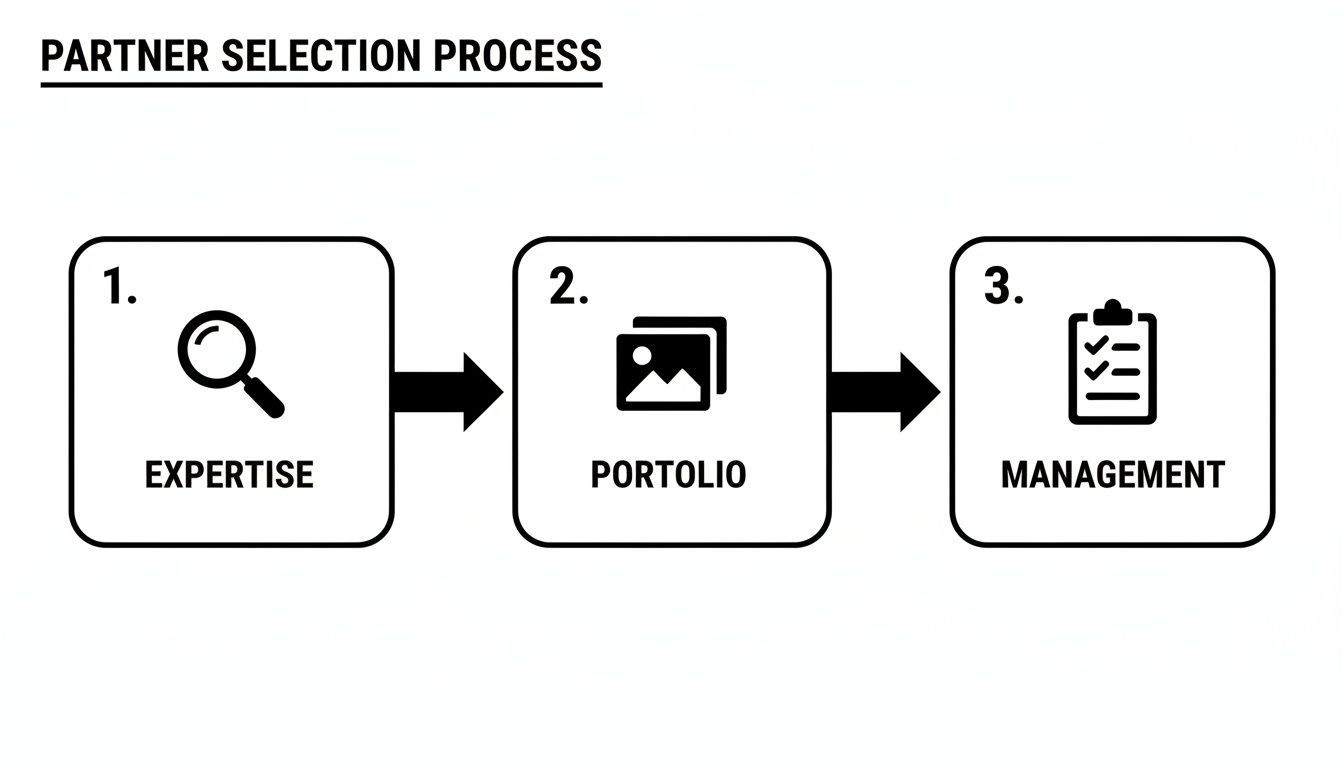
As illustrated, partner selection must extend beyond a portfolio review to a rigorous assessment of expertise, management discipline, and strategic capability.
Budgeting for Impact
The cost and timeline for 3d architectural rendering services are functions of complexity. The market offers a wide spectrum, with exterior renders starting from $350-$800 and complex cinematic animations ranging from $4,000-$15,000 per minute. This variance reflects the level of detail, asset quantity, and artistic skill required. Technologically advanced partners with efficient workflows can deliver premium quality with greater cost-effectiveness. For a deeper analysis, you can explore 3D rendering market sizing on Towards Packaging.
A well-managed workflow delivers predictability. Incorporating strategic feedback loops at key milestones—such as after initial modeling and draft renders—prevents expensive, late-stage revisions and ensures the final assets are perfectly calibrated to achieve your marketing objectives.
This structured methodology transforms a creative process into a reliable production pipeline, delivering powerful sales tools on time and on budget—the engine of a successful pre-construction marketing campaign.
The Future of Real Estate Sales: A Visualization-First Strategy
The era of treating 3D architectural rendering as a decorative, last-minute addition to a brochure is over. For forward-thinking developers, visualization is the core operating system of the entire sales and marketing apparatus—fueling every stage from initial investor buy-in to the final pre-construction sale.
Integrating visualization as a foundational element from project inception is the single most impactful lever a development team can pull. The creation of a photorealistic, interactive digital twin before breaking ground establishes a central source of truth.
Every marketing campaign, every virtual sales gallery experience, and every stakeholder communication is drawn from this unified vision. The result is unwavering consistency and clarity that transforms the sales model from reactive to proactive, creating a powerful, self-sustaining sales ecosystem.
Adopting a Visualization-First Mindset
The most sophisticated developers are moving beyond transactional, project-by-project rendering commissions. They are forming long-term partnerships with visualization experts who develop a deep understanding of their brand, target demographics, and business objectives. This symbiotic relationship creates a scalable, repeatable playbook for launching projects with greater speed and reduced risk.
The objective is to create a virtual sales experience so compelling and informative that it not only rivals the traditional physical sales gallery but surpasses it. This is the mechanism for collapsing sales cycles and accessing a global buyer market.
This strategic shift extends beyond a single project's success. As explored in our case study on how virtual reality transforms pre-construction sales, this approach builds a more resilient and profitable sales model across an entire portfolio.
The strategic imperative is clear: stop viewing renderings as an expense. Start treating visualization as the cornerstone of a modern, technology-driven sales strategy that secures your project’s financial success from day one.
Frequently Asked Questions
When evaluating 3D architectural rendering services, several key operational questions arise concerning timelines, risk mitigation, and design flexibility. Securing clear answers is essential for integrating visualization seamlessly into your launch strategy and ensuring a positive return on investment.
Clear upfront communication builds confidence and ensures strategic alignment between your project team and your visualization partner, preventing costly downstream misunderstandings.
How Long Does It Take to Produce a Set of Architectural Renderings?
Timelines are dictated by the scope and complexity of the asset package. A single, high-quality exterior rendering can often be produced within one to two weeks. A comprehensive marketing package for a new development—including multiple interior and exterior views, a cinematic animation, and a virtual tour—typically requires a six to twelve-week production timeline.
Key variables influencing this timeline include:
The completeness and clarity of the initial architectural plans provided.
The number of feedback and revision cycles incorporated into the process.
The final rendering computation time, which is a function of image complexity and resolution.
A professional visualization partner will provide a detailed project schedule at kickoff, outlining all milestones to ensure full transparency and alignment with your marketing deadlines. This predictability is crucial for a successful pre-construction launch.
What Is the Biggest Mistake Developers Make When Commissioning 3D Renders?
The most common and costly mistake is treating 3D visualization as a commodity and selecting a vendor based solely on the lowest price. This approach almost invariably results in assets that lack the photorealism and emotional resonance required to connect with discerning buyers. The consequence is an undermined marketing budget and a compromised brand perception from the outset.
A true strategic partner invests time to understand your target buyer, brand positioning, and commercial objectives. The goal is not merely to produce images, but to engineer assets that attract qualified leads and accelerate sales. Therefore, the evaluation criteria must prioritize portfolio quality, a proven track record, and communication over price alone.
Can 3D Renderings Be Updated if Designs Change?
Yes, but the timing of the change is critical. Minor design modifications made early in the process, during the 3D modeling phase, are typically straightforward to implement.
However, change requests made after detailed work—such as texturing, lighting, and final rendering—has been completed constitute a significant revision. Such late-stage changes will impact both the project timeline and budget. To mitigate this, a professional workflow incorporates formal sign-off stages at key milestones, allowing your team to approve the design before it progresses, thereby minimizing the need for costly late-game revisions.
At The Render Pros, we function as a strategic visualization partner for developers. We translate architectural vision into powerful marketing assets designed to de-risk projects and accelerate the path to profitability. Discover how our integrated approach can elevate your next development at https://therenderpros.com.
Article created using Outrank